
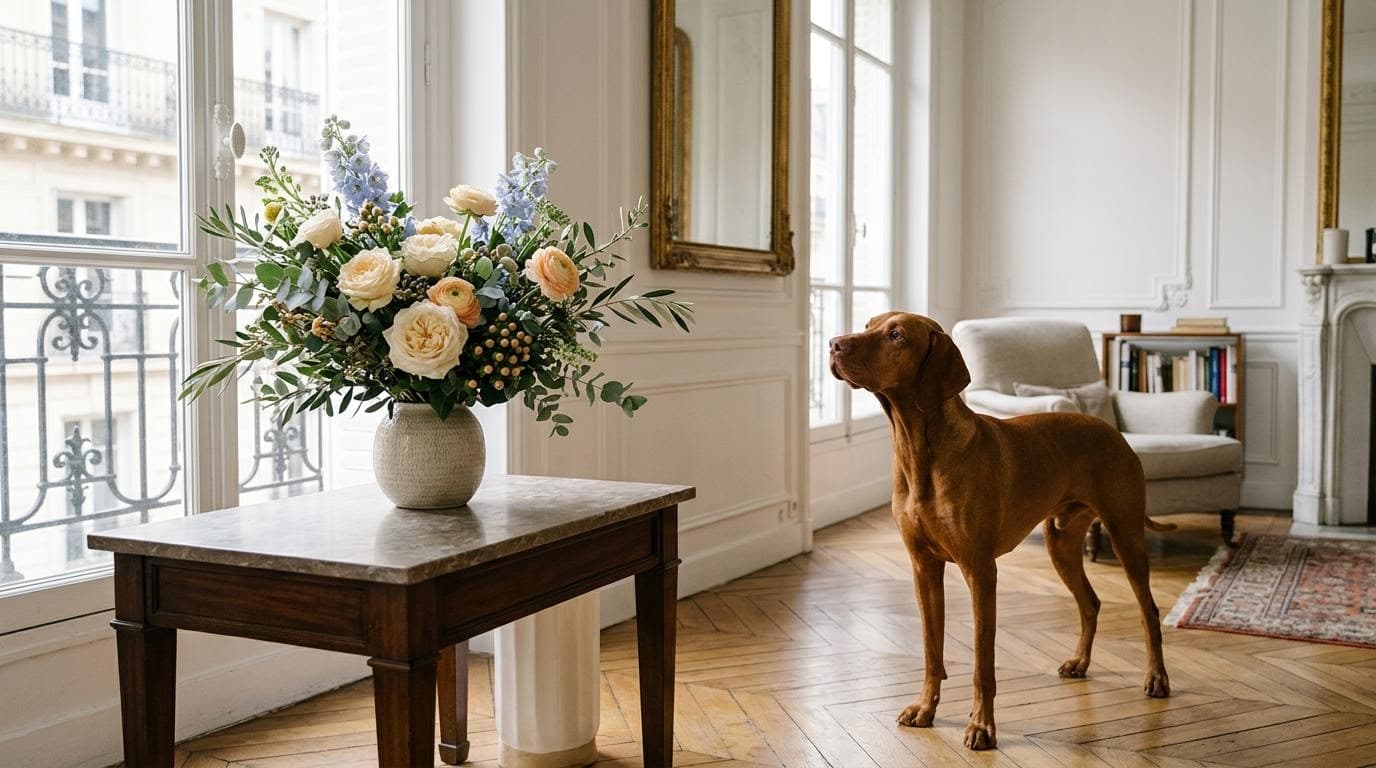
Flowers and Pets: Which Bouquet Stems Can Harm Cats and Dogs
Fresh flowers make a room feel sharper, softer, more alive. They change the air without saying a word. But when you share that space with a cat or a dog, a bouquet stops being just a pretty object and becomes something else too: a small question of judgment.
Because pets do not admire flowers the way we do.
They investigate. They sniff. They drink the vase water like it was curated for them personally. A dangling stem becomes prey. A dusting of pollen becomes a grooming problem five minutes later.
So this is not about panic. It is about clarity.
Let’s say the quiet part out loud: there is no magical rule that says all bouquet flowers are safe. Even non-toxic stems can still cause stomach upset if chewed. But a few flowers are in a different category altogether, and those are worth memorizing. Veterinary sources consistently single out true lilies and daylilies as especially dangerous for cats, and they also identify lily of the valley, foxglove, and gloriosa lily as serious risks for pets.
The four names worth remembering first
We are not building a 200-item panic list. Nobody needs that.
But there are four groups that deserve a permanent place in your memory.
1. True lilies and daylilies — Lilium and Hemerocallis
If you live with a cat, this is the major red flag. True lilies (Lilium) and daylilies (Hemerocallis) are extremely dangerous to cats. Not just the petals. Not just the leaves. The entire plant is a problem — including pollen and even the water in the vase. A tiny exposure can be enough to trigger acute kidney injury, and early treatment matters enormously. Dogs may develop milder gastrointestinal signs, but these stems are still not something to treat casually.
2. Lily of the valley — Convallaria
It is not dangerous in the same way as a true lily, but it is still absolutely a flower to avoid around pets. Lily of the valley contains cardiac glycosides, which can affect the heart and cause vomiting, diarrhea, weakness, and irregular heartbeat. Even the vase water is considered unsafe after contact. Pretty, yes. Innocent, no.
3. Foxglove — Digitalis
Foxglove is what happens when a flower looks cinematic and behaves like a villain. It contains cardiac glycosides as well, which can lead to vomiting, diarrhea, weakness, dangerous arrhythmias, cardiac failure, and in severe cases death. It is one of those stems that earns admiration from a distance and exclusion from a pet-friendly bouquet.
4. Gloriosa lily — Gloriosa superba
Gloriosa is not a “maybe it will be fine” flower. It is toxic to both cats and dogs, and the toxic principles are colchicine-related alkaloids. Reported signs include salivation, vomiting, bloody diarrhea, shock, kidney failure, liver damage, and bone marrow suppression. In other words: gorgeous, dramatic, and not worth the risk in a pet household.
What else deserves caution
Then there is the second tier: flowers that are not in the same headline-grabbing category, but still should not be treated like chew toys.
Tulips, daffodils, chrysanthemums, delphiniums, ranunculus, hydrangea, and eucalyptus all deserve caution. In some of these plants, the highest concentration of toxins is found in bulbs, tubers, or rhizomes — parts you usually do not have in a bouquet — but leaves, stems, sap, pollen, and vase water can still cause unpleasant reactions if a pet gets involved. Calla lilies are a separate case: ASPCA identifies them as toxic to cats and dogs because of insoluble calcium oxalates, which can cause intense oral irritation, drooling, vomiting, and trouble swallowing.
On the calmer side, ASPCA lists several common bouquet flowers as non-toxic or safer options for homes with pets, including roses, gerbera daisies, orchids, snapdragons, freesia, limonium, stock, statice, lisianthus, and alstroemeria. That does not mean your dog should eat half the arrangement for sport, but it does mean these are usually far more workable choices when animals are part of the household.
So can you keep a bouquet around pets at all?
In most homes, yes — with rules.
A bouquet is usually manageable when:
it stays well out of reach;
your pet cannot drink the vase water;
loose pollen is not falling onto accessible surfaces;
nobody is chewing stems, leaves, wrapping, dried botanicals, or decorative grasses.
That is the grown-up answer. Not fear, not denial — distance.
Because for most stems, the main issue is not that they merely exist in the room. The issue is contact. A cat brushes against pollen, then grooms. A dog steals a leaf, then goes back for more. A pet drinks vase water because, obviously, your fresh arrangement has now become a beverage program. That is usually how trouble starts. With true lilies and cats, the threshold is much lower, which is exactly why they belong on the hard no list.
Why we still recommend a little distance even with the “safer” stems
Cut flowers travel. A lot.
They are grown in different countries, handled under different production systems, processed after harvest, transported through different supply chains, and kept alive with various storage and hydration products before they ever reach your table. You do not see every treatment, every rinse, every holding solution, every stop between field and vase.
So even with relatively gentle stems, close contact is not something to encourage. That is not paranoia. That is simply good sense.
And there is another point people forget: “grown in a field” does not automatically mean harmless. Wild grass seeds can irritate tissue. A sharp awn can lodge where it should not. A flower can look soft and still cause a very hard evening. Nature has never signed a contract promising to be safe just because it photographs beautifully.
Signs that deserve attention
If your pet chewed part of the bouquet, licked pollen, drank the vase water, or simply started acting off after contact, watch for:
vomiting;
diarrhea;
drooling;
loss of appetite;
lethargy;
weakness or wobbliness;
dilated pupils;
swelling of the mouth, lips, or face;
skin irritation, rash, or unusual spots;
breathing difficulty;
tremors or seizures;
irregular heartbeat.
The pattern depends on the plant. Sometimes it is local irritation. Sometimes it is the kidneys. Sometimes it is the heart. Sometimes it is several systems at once. The point is not to self-diagnose your way into a delay.
If your pet did get into the bouquet
Do not wait for tomorrow to see how the mood evolves.
If you suspect your cat or dog swallowed part of an arrangement, drank the vase water, or changed behavior after contact, treat it as something that needs attention now.
What helps most in the first minutes is simple:
remove the arrangement and any fallen plant material;
check what is missing — leaf, petal, stem, pollen, water;
take a photo of the bouquet;
keep the flower wrap, label, or any stem you can identify;
call your veterinarian as quickly as possible;
and if the bouquet came from a florist, contact the shop too so the flower names can be confirmed fast.
Do not improvise at home. Do not induce vomiting unless a veterinarian tells you to. Do not assume activated charcoal is a chic universal solution. In real cases, speed and plant identification matter more than heroic guessing. And if a cat may have been exposed to a true lily, time matters a great deal.
The good news
You do not need to ban beauty from the house and live like a minimalist hostage to pet safety.
You just need a little discernment.
A few stems deserve a hard no. A second group deserves distance and supervision. Everything else can usually be enjoyed quite peacefully when the arrangement is placed thoughtfully and your pet is not invited into an intimate relationship with it.
A bouquet should lift the room.
Not end with an emergency vet bill and a guilty-looking dog.
And if you want something beautiful without second-guessing every stem, send us a message on WhatsApp. We’ll help you choose flowers that won’t disturb your favorite member of the family.