
1) Mimosa in France: what it actually is (botany, but readable)
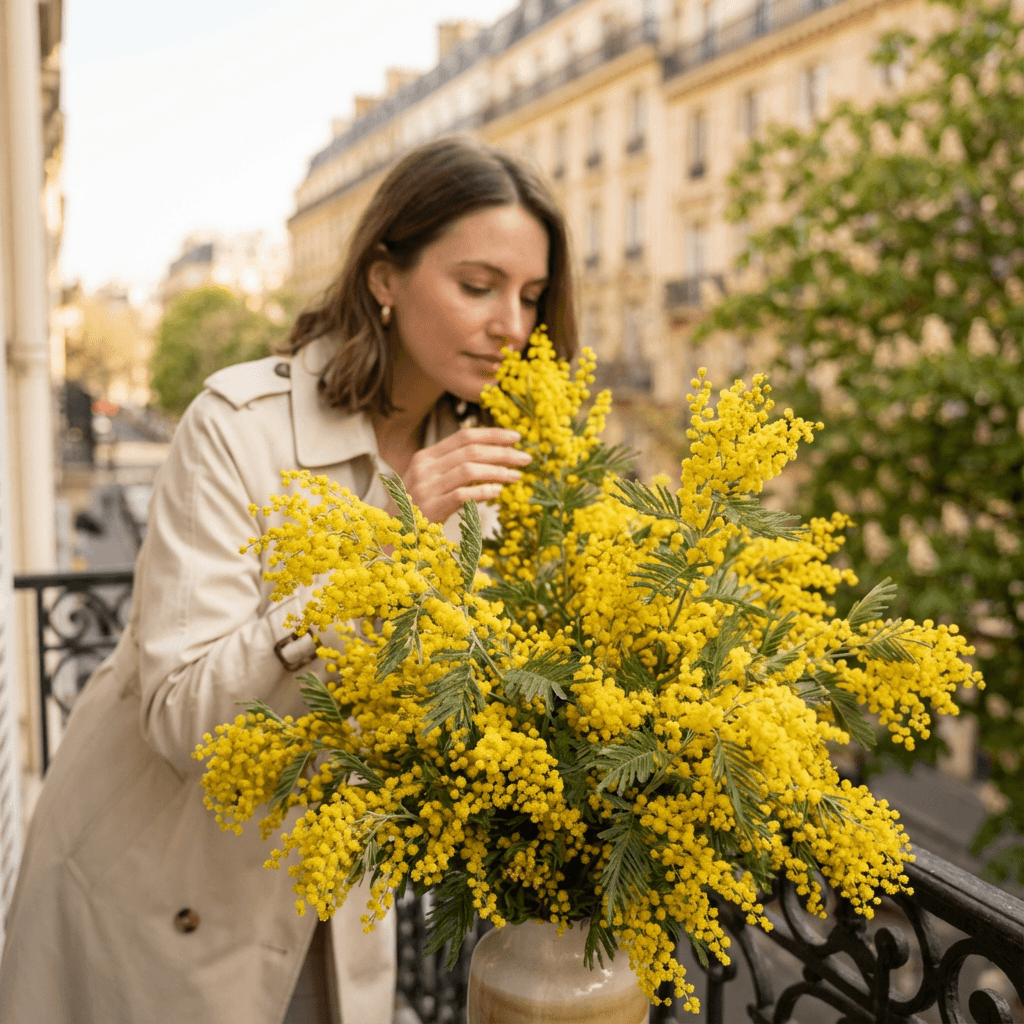
In French flower shops, “mimosa” almost always means Acacia dealbata (silver wattle): a legume-family acacia with airy, silver-grey foliage and a winter bloom that feels like someone turned the lights back on.
Here’s the detail that makes it even more fascinating: protogyny is described in Acacia dealbata. In simple terms, the female phase can appear before the male phase in the same flower—one of nature’s ways to reduce self-pollination and improve pollination success. Translation: the plant doesn’t rush. It has a plan.
“Are those little yellow balls the flowers?”
Yes. But they’re not “petals in a pom-pom.”
What you see as fluffy balls are globular flower clusters (often described as glomerules/heads). Each “pom-pom” is made of many tiny flowers (not just one), commonly around 13–42. And the cloud-like softness comes mostly from the stamens—that’s what creates the volume, the velvet look, the golden haze.

Those small heads are then grouped into larger panicles (like bunches), which is why a mimosa branch can look like a whole galaxy of tiny suns.
And no, the fluff isn’t “decoration.” Lots of stamens means lots of pollen—better odds for pollination. In nature, mimosa is a real magnet for pollinating insects.
Where it came from—and where it thrives in France
Acacia dealbata is native to Australia. In France, it became a true winter icon in the South-East—Var and Alpes-Maritimes, around Tanneron, Pégomas, Mandelieu-La Napoule and Grasse. Mild winters and bright light suit it perfectly. Sometimes a little too well: in some areas it’s considered invasive, capable of outcompeting local flora. Beautiful, yes—yet ecosystems are not decoration sets.
2) When to buy mimosa (and why Paris sees it so early)
You’ll often hear the flowering season described as January to March (sometimes into March–April). Some producers have very early material—occasionally as early as late December.
In Paris, garden bloom peaks later (late winter to early spring), but retail availability can start earlier because supply comes from milder regions and earlier varieties. And yes: the gentler the winter, the earlier the season tends to start. Living things don’t follow calendars.
3) Harvest stage: why your mimosa keeps opening at home
There’s a florist truth worth knowing: mimosa is often cut at a stage that travels well, then continues opening after it arrives. That’s why two bunches bought a week apart can look like entirely different characters.
There’s also forcing: after harvest, opening can be “kick-started” in controlled conditions. If you love flowers with geography, the Côte d’Azur’s Route du Mimosa is basically a celebration of that short, bright, almost cinematic moment.
And yes—on the technical side, there are professional flower care products formulated specifically for mimosa to support hydration and opening when used correctly. Not magic. Chemistry. Still impressive.
4) What mimosa means (and why people gift it)
Mimosa doesn’t have one universal meaning—it changes with culture. But a few messages translate almost everywhere:
Sun in the middle of winter. When everything is grey, mimosa arrives yellow. End of discussion.
Early awakening. It feels like the season starts a little ahead of schedule.
A gesture without drama. A simple “I thought of you.”
Softness with backbone. It looks delicate, yet it holds space.
Italy — March 8 (Festa della Donna)
In Italy, mimosa is a cultural code around March 8: not a romantic declaration, but a calm, social gesture that says: I see you, I respect you, I support you.
France — Côte d’Azur winter festivals
In the South of France, mimosa is winter light made into a tradition, with events like Fête du Mimosa in Mandelieu-La Napoule and the Route du Mimosa from Bormes-les-Mimosas to Grasse.
5) Mimosa in perfumery: why it smells “powdery” and refined
Perfumery often uses mimosa absolute—an extract obtained via solvent extraction from flowers and small plant parts. In the heart of a fragrance, mimosa brings:
a powdery softness,
a gentle floral “cloud,”
sometimes honeyed, sun-warm nuances.
And Grasse matters here: it’s historically tied to perfumery culture, and mimosa is one of those winter ingredients that feels like a signature.
6) Allergy & pets: what to know at home
People: allergies are possible. Mimosa is mostly insect-pollinated, so reactions are more common up close (indoors, handling stems) than from widespread airborne exposure. If you’re sensitive, don’t place it in the bedroom, ventilate well, and avoid drying it in small rooms.
Pets: mimosa is not food. Keep it out of reach, discourage chewing, and if anything odd happens (drooling, vomiting, lethargy), call a vet.
7) How to choose mimosa (in your hands)
Not at peak yet (often lasts longer):
tighter heads, less “cloud”
softer yellow, sometimes greenish tips
firm branch, minimal shedding

At peak (the most “wow”):
maximum fluff, bright yellow
stronger scent
stunning—but it evolves faster

Past peak:
colour shifts toward ochre/mustard
drier texture, easier shedding
foliage starts to dry/yellow

8) How to keep your mimosa looking its best
Mimosa is wonderfully ephemeral. In a cool home (around 18–20°C), you’ll often get:
3–5 days of “wow” freshness,
then another 1–2 days more delicate and dry—still pretty, almost like a gentle dried look.
The science is simple: vase life is a balance between water uptake and water loss (transpiration). Reasonable leaf reduction can help—but don’t overdo it.
Care at home
If your mimosa is still very closed and green, you can help it start gently in a slightly warmer room and water (not hot), then move it back to cool.
Remove wrapping immediately.
Wash the vase. Bacteria = blocked stems = game over.
Refresh the cut with pruners (woody stems; scissors crush).
Use plenty of water: stems in water, foliage kept out. Room-temperature water.
Keep away from radiators, stoves, candles, direct heat.
Change the water daily.
Why it sometimes won’t open:
cut too green and not conditioned
vessels clogged (old cut + bacteria)
too hot/dry indoors
shocky temperature swings
9) Mimosa bouquets in Paris: the best pairings
Mimosa + eucalyptus
The Paris interior classic: silver line + golden light. It also tends to dry beautifully, without becoming sad.
Mimosa + ranunculus
The softest, happiest seasonal pairing—perfect as a birthday gift: tender, bright, never cliché.
Mimosa + tulips
Modern and graphic: smooth tulip shapes against mimosa fluff—very current, very clean.
Mimosa + genista (broom)
More volume, more sun, more scent—for people who like a bouquet that’s unapologetically present.
Mimosa is the fastest way to add light to January. You choose the mood—we’ll take care of freshness, style, and delivery across Paris.