
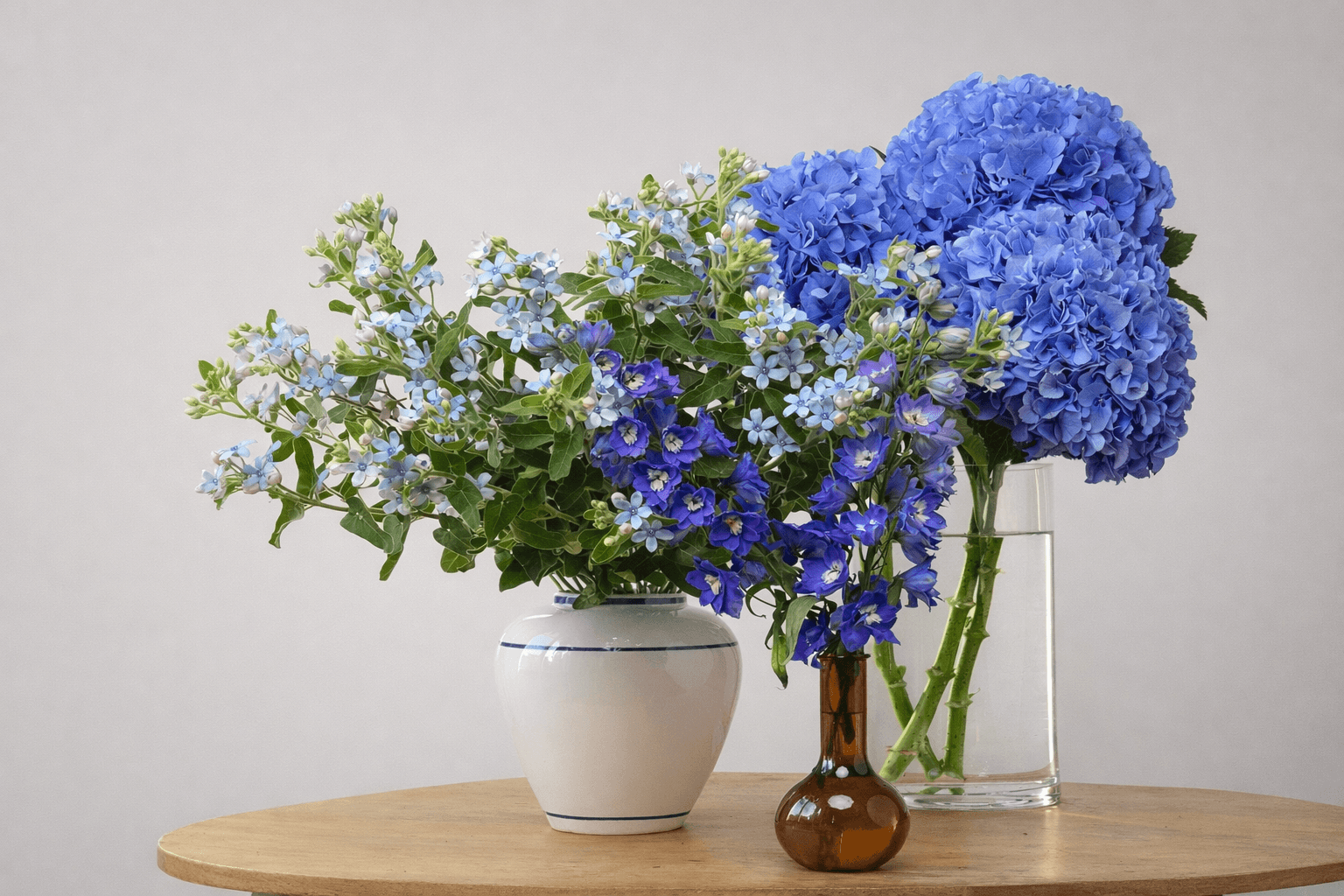
The Vase: the tiny detail that changes everything
Let’s be honest: truly fresh flowers can still look great in a less-than-perfect vase.
But if you want your bouquet to stay beautiful longer, consistently, there’s no magic trick—what matters is clean water and a vase that helps you keep it that way.
A vase is a little ecosystem. If it’s hard to clean, if it holds onto that invisible slippery film at the bottom (hello, biofilm), bacteria settle in. Then the stems of the flowers don’t take up water as well—and the bouquet starts fading sooner than it should.
So here’s the gentle, no-myths guide—like we’d tell a friend who just wants to enjoy their flowers at home, stress-free.
Glass — the safest bet
Glass doesn’t have to mean a clear cylinder. It can be smoked, colored, frosted, ribbed, faceted. The key: the inside should feel smooth.
Why we love it
It cleans “all the way clean.”
It doesn’t hold odors or residues.
You can actually see the water, so you notice fast when it’s time to refresh it. Simple—and it works.
Avoid
Glass that’s painted on the inside. Yes, it’s a thing. When that coating starts to flake, it’s not just sad—it can end up in the water. Choose glass that’s colored through the glass (not painted inside), or coated on the outside only.
Ceramic — gorgeous, but higher maintenance
We get the appeal. Ceramic looks warm, chic, very “home.” It just asks for a little more attention.
Pros
Often the prettiest option in an interior.
If the inside is fully glazed and smooth, it can be as clean-friendly as glass.
Cons
You can’t see the water level. Sometimes a few stems aren’t even touching water (and the bouquet goes uneven).
Tiny chips or hairline cracks inside become residue hideouts—harder to wash back to “zero.”
On the outside, ceramic can show pollen, green marks, and water rings. Not dirty—just not always pretty.
The best compromise
Ceramic outside, glass inside. A simple glass insert gives you style and clean water.
Metal — stunning, but not a true vase (unless you use an insert)
Metal, brass, pretty buckets, decorative containers: love the look. But it’s not ideal for bouquet water—especially if you use flower food.
Why
Flower food and professional solutions are often slightly acidic (that helps stems hydrate and keeps water balanced). Metal can react, oxidize, or change the water.
Rule of thumb
Use metal as the outer shell. Put a glass container inside. That’s exactly how pros get the aesthetic without sacrificing vase life.
What about enamel metal (like vintage milk jugs)?
Enamel can work if the enamel is perfect inside (no chips). The moment there’s a ding or rough spot: switch to a glass insert.
Plastic / acrylic — handy, mostly for small bouquets
Yes, people do have plastic or acrylic “vases” at home: light, unbreakable, easy.
Pros
No shattering.
Fine for a small bouquet, a bedroom, or a very busy household.
Cons
Scratches easily. Micro-scratches trap residue, so it’s harder to keep truly clean.
Often less stable: a dense bouquet, the edge of a table, a curious cat… you know.
Our verdict
Great as a backup or for small formats. For a generous bouquet: glass.
Concrete — so cool, but watch for surprises
Concrete has that raw, modern, atelier vibe. We get the crush. But concrete can be porous.
Know this
If it isn’t properly sealed and waterproof, it can weep moisture—or even leak.
Over time you can see white marks (a normal reaction when water sits in/near porous material).
No-surprises rule
Concrete only if the maker clearly says it’s sealed/waterproof—or use a glass insert. Quick test: fill it with water, place it on paper towel for a few hours. If it marks: insert required.
Soft conclusion
Want the simplest answer? Choose glass. Clear, smoked, colored—doesn’t matter. As long as the inside is smooth and easy to wash.
And if your dream vase is ceramic, metal, or concrete—perfect. Keep it. Just slip a glass insert inside.
You get the look. Your flowers get clean, stable water. No surprises on the table. No surprises on the floor.
How to wash a glass vase (for real)
You’re not aiming for “looks clean.” You’re aiming for truly clean.
That invisible slippery layer (biofilm) makes water turn faster, stems hydrate worse, and the bouquet loses energy.
The easy home routine
Hot water + dish soap
Rinse right away, then hot water and a drop of soap.
Pro tip: a bottle brush is everything—sponges don’t reach the bottom properly.If it feels slimy / smells / water turns fast: bleach (the sensible way)
Fill the vase with water, add 1 teaspoon of bleach per 1 liter of water, leave 5–10 minutes, brush, then rinse very well (2–3 times).
Safety, quickly
Wear gloves if your skin is sensitive.
Ventilate the room.
Never mix bleach with vinegar or other acids.
Rinse until there’s no smell left.
If the glass looks cloudy or has limescale: white vinegar
Yes, it really works—for mineral buildup.
Half warm water, half vinegar. 15–30 minutes, brush, rinse.
Vinegar is great for deposits, but not the most reliable “disinfectant”—bleach (well-rinsed) is more effective.Narrow neck, no brush?
A little baking soda + warm water. Shake, wait 10 minutes, rinse.
(Then treat yourself to a bottle brush. Worth it.)
Avoid
“Quick rinse and done” (biofilm stays).
Abrasive pads (they micro-scratch glass and future grime sticks faster).
Leaving soap in the vase (rinse until water feels neutral).
Le Feu rule
A spotless vase = steadier water = flowers that hydrate better.
Often the difference between “cute for 48 hours” and “beautiful for days.”
Vase shape: what actually works (and what causes the “hourglass” bouquet)
The vase shape isn’t just decor. It’s structure. It supports stems, guides the silhouette, and prevents that classic “hourglass” look: tight at the bottom, exploding at the top, then collapsing.
The simple rule that works most of the time
For rounded mixed bouquets: choose a glass cylinder or a slightly flared vase with a stable base.
The bigger the bouquet, the more you need stability and a mouth wide enough for the bouquet’s “tie point” (where stems naturally gather).
Be careful with vases that are narrow at the bottom and wide at the top
Pretty on a shelf. Often messy with real bouquets:
stems compress at the bottom → they bend or bruise
the top spreads too much → hourglass silhouette
bouquet looks tired sooner because it’s poorly supported
Florist tricks (no new vase required)
If the bouquet wants to fly apart: keep it tied for the first few hours. It holds the shape beautifully.
If the vase is tall and opaque: you can raise stems with a small clean support at the bottom (then double-check all stems still reach the water).
By flower: the right vase changes everything
Tulips
Tulips keep growing and follow the light. They like support.
a taller vase (at least half the stem supported)
a narrower neck or cylinder
not too wide—unless you have a very large bunch (think 50+ stems)
Hydrangeas
Thick stems, heavy heads, thirsty.
a very stable vase
a wide enough opening so stems aren’t crushed
and plenty of water (no half measures)
Roses
Classic balance.
medium-tall, stable base
opening not too tight, not too wide
A simple cylinder is perfect.
Mimosa
Mimosa loves air—without chaos.
a taller vase to support the branch (around 10–12 in / 25–30 cm)
a medium opening: enough space to show volume, not so wide that everything falls outward
easy to clean, because mimosa = water changed daily
The Le Feu shortcut: the 3-vase home kit
If you don’t want to overthink it, have a few “reflex” vases:
Mini vase for 1–2 stems
Small vase (6–8 in / 15–20 cm) for short bouquets: 10 tulips, scabiosa, ranunculus
Medium vase (12–14 in / 30–35 cm) for seasonal mixed bouquets (slightly wider base, a bit narrower at the neck)
Tall vase (around 20 in / 50 cm) for big stems and branches: hydrangea, amaryllis, magnolia—must be very stable
You pick the mood. The vase holds the rest.
And if you don’t want to wonder “do they even own a vase?”
You can send a design already in its container—ready to place, zero fuss, perfect on arrival.
Two examples on our site: