
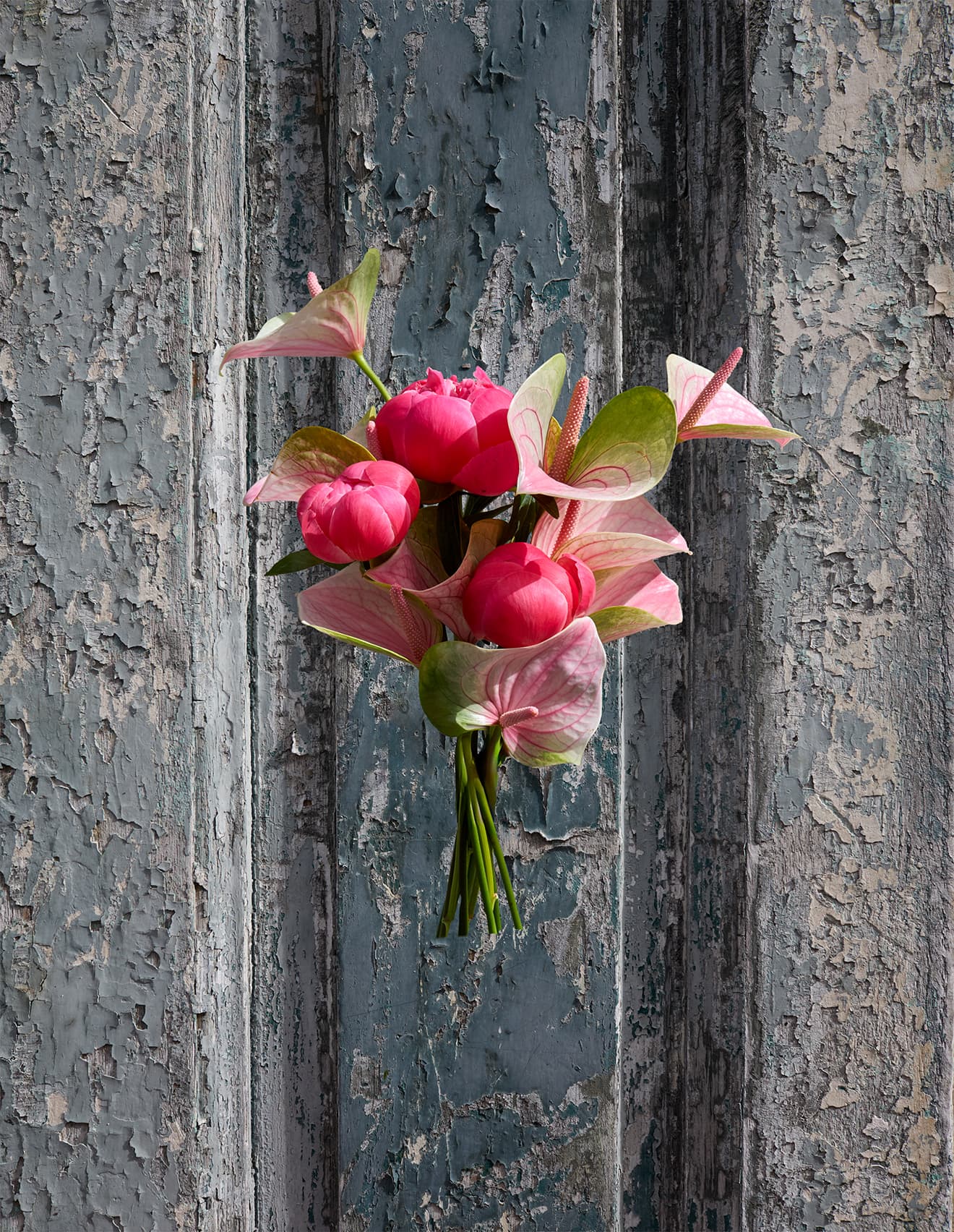
Here, in one place, what's worth knowing before you choose yours: why a bridal bouquet is not an ordinary bouquet, the three shapes that really exist, how to decide on colour when the dress is white, how to read flower durability against the length of your day, what we see coming in 2026 brides, and how to think bridesmaid bouquets and boutonnière as one gesture.
Why a bridal bouquet is not an ordinary bouquet
A bouquet on a table lives in its vase. A bridal bouquet lives in the hand, for hours, under direct light, inside a long, dense day. It isn't a miniature of the same object — it's a different object.
First, the construction. The stems are bound tightly, sometimes on several levels, so the bouquet doesn't move in the hand and the silhouette holds in the photograph. A ribbon is wound the full length of the stems. The bouquet isn't built to stand in a vase through the day — it's built to be carried out of water and return to drink between moments.
Second, the density. Even a visually small bridal bouquet asks for many flowers, because they're packed against each other without air. That's why the price isn't proportional to its visible size. A compact garden ball of 25 cm can hold as much material as a 60 cm home bouquet for the living room. The handwork counts differently too: balancing the silhouette in the hand, anticipating movement, planning the weight — a craft of its own.
Third, the time. The bouquet lives the evening before, sometimes hours in the car, the morning of getting ready, the ceremony, the photoshoot in the sun, the cocktail hour, sometimes well into the evening. No ordinary bouquet crosses such a day. That's why the conversation with your florist about varieties looks like no other order.
Three shapes: round, asymmetric, cascade
Other shapes exist, but most bridal bouquets fall into three families, and choosing between them is already choosing a type of bride.
The round bouquet, often called a posy, is the classical shape: a dense sphere, short stems, compact, readable silhouette. It works with a structured dress, sheath, princess, mermaid, with worked detail at the back. It's also the shape photographers handle best — predictable, poses well. Choosing round today isn't a lack of imagination. It's a decision for clarity.
The asymmetric bouquet has a deliberate tipping point — usually a large flower or a branch leaving the silhouette to the left or to the right, pulling the eye. It works with a clean-cut dress, with a bride who doesn't want to repeat a frame she's already seen a thousand times. You have to know how to carry it — it isn't symmetric in the hand, it has a direction, and the bride should know which.
The cascade, or trailing bouquet, drops in a free fall toward the floor. It disappeared from magazines for years, and it's coming back in 2026. It works beautifully with a simple, almost minimalist dress, which it extends as a second, plant-like skirt. It also asks more of the photographer — it's a silhouette to be earned.
Colour — not white on whiteIf the dress is white or ivory, an all-white bouquet is almost never the best choice. To the eye, in the room, it looks elegant. In the photograph, especially under strong light, it dissolves into the dress. Visually you're holding something that has no longer any edge. The photo loses one of its anchors.
The fix isn't necessarily a loud colour. It's introducing contrast, even through a dark leaf, a tighter bud, a more saturated centre. But the honest truth is this: the bouquets that mark the photographs are coloured. A bride in white with a terracotta bouquet, or oxblood, or deep blue, or a mix of dark roses against off-whites — those are the photos that stay.
Choose what you actually love. Not the room palette. Not the theme palette. Your favourite colours are already the right ones, otherwise you wouldn't love them. If your parents or grandparents carried particular flowers in their bouquets, that's a memory worth bringing back into yours. The truest bouquet is often the one that speaks to several generations at once.
Varieties — your favourites first
Before the trends, two simple questions: which flowers do you really love? And is there one that ties you to someone — your mother, your grandmother, a great-aunt?
Those two questions weigh more than any seasonal list. A bride carrying lily of the valley because her mother carried it, or peonies because her grandmother grew them, says something a stylist can't invent. That density is what we look for in a bridal bouquet, more than novelty.
That said, you have to account for the season and what's actually available. Some flowers aren't reachable in Paris in March (tulips), in November (ranunculus), in deep summer (good-grade peonies). A proper conversation at the time of the order solves it: if your favourite isn't in season, we look for a cousin — by colour, by texture, by gesture of the flower.
Durability — short ceremony or full day
The topic most often forgotten, and the one that decides whether the bouquet looks alive at 2 p.m. and tired by 10 p.m.If the wedding is a short ceremony with a photoshoot, no long evening, almost any flower is possible — including notoriously fragile varieties like hydrangea, lilac, certain poppies, early ranunculus. You can have anything.If the day is long — ceremony, drinks, dinner, dancing — choose with your florist varieties that hold out of water through the end. Quality roses, garden-grade carnations, lisianthus, eucalyptus, some anemone varieties (watch the heat), many orchids, hold very well. Very open peonies, hydrangeas, lilac and poppies can start to tire after six or seven hours out of water. That's not a reason to leave them out — it's a reason to place them at the heart of the bouquet, surrounded by sturdier varieties that hold the composition through.
Tell your florist your timeline at the moment of the order. Season, ceremony hour, location (open sun, air-conditioned room, garden under a tent) all change which varieties get chosen.
Living isn't imperfect. It's true
Something no catalogue says: a fresh-cut bouquet can't be homogeneous. Not every flower opens at the same rate. A rose can be wide open while the one next to it is still a cup. Shades vary — a peony of the same name, bought ten days apart, doesn't carry the same centre tone.
That's what makes a bouquet alive. A photograph of a bouquet where every flower is identical, calibrated, opened to the same degree, is almost always a photo of an artificial bouquet — or a bouquet retouched in post. A real one has variations, transitions, flowers slightly more open than others. And daylight loves that.
Accept the living part, and the bouquet looks like you. Look for smooth perfection, and it looks like anyone.
The bouquet looks like the bride, not the cover
A bridal bouquet isn't an accessory to complete the dress: it's an object that extends the bride. Its shape, its rhythm, its palette say something about the person holding it.
A bride who doesn't recognise herself in her bouquet knows it from the photograph, years later. That's why at the order stage we spend more time on you than on the flowers: dress, venue, light, what you look at, what irritates you in the bouquets you've seen, what you've carried for a long time. The bouquet comes out of that conversation, not out of a catalogue.
Our vision for 2026 brides
What we see coming in the first orders and conversations of the season.
One. The end of dusty pastels. Powder pink, eucalyptus alone, off-white on off-white have dominated for ten years. They're stepping back. In their place, dense palettes: terracotta, oxblood, smoky bordeaux, deep mauve, near-black greens. A bride in white with a terracotta bouquet is more modern today than a bride with an ivory one.
Two. Asymmetry as a statement. Round stays, but more than half the bouquets ordered for summer 2026 are asymmetric or cascade. A clear marker: this isn't a catalogue wedding.
Three. Mono-bouquets. One variety, dense, sculptural. Black anemones, coral peonies, white caspia, chocolate ranunculus. Anti-mille-fleurs, anti-Pinterest. The strength is in repetition, not diversity.
Four. Family flower codes. The grandmother's lily of the valley, the childhood garden's lilac, the mother's kitchen ranunculus. Personal symbolism wins over the trending palette. Many brides arrive with an old photograph and ask us to find the gesture, not to copy.
Five. Asymmetric mini-bouquets for the bridesmaids. End of the uniform. Each bridesmaid carries a different small bouquet in a shared palette. Each keeps her personality, the group keeps its coherence.
Six. Wild garden over coiffed. Less 360-degree tight ball, more local seasonal varieties, looser movement, stems that escape the silhouette. A reading closer to a July garden at the end of a hot day than to a workshop bench.
Seven. The boutonnière as a manifesto. The white rose pinned to the lapel is stepping back. In its place, a black anemone, an olive branch with a single fruit, a feather, a small chosen dry stem. For the groom, his witnesses, sometimes his father. Small — but it says something.
Bridesmaid bouquets and boutonnière, one gesture
A bridal bouquet never works alone. It needs visual answers — the bridesmaids' bouquets, the groom's boutonnière, sometimes a crown, a shoulder accent, a hair detail. Together they make up a visual grammar that reads on group photos and on the film.
For the bridesmaids, two schools. Uniform: the same bouquet in several copies, same palette, same shape. Readable but frozen. Variation: each one a different small bouquet in the shared palette. Alive, truer, more modern. Our preference is the second, unless there are many bridesmaids and the ceremony is very structured.For the boutonnière, the rule is restraint. One flower or one branch, fixed on the lapel, not wider than the groom's hand. It has to last the day, which rules out fragile flowers (peony, hydrangea). It can echo a variety from the bouquet, or instead answer the palette without repeating it. Olive with a fruit, a dark anemone, an orchid, a stem of caspia.
The anniversary — remake the bouquet
Something we tell every bride at the order: on every anniversary, you can ask us to remake a similar bouquet. Not identical — a real bouquet never is — but in the same palette, the same shape, with the same varieties when available.It's a gesture that pays back emotionally far more than it costs. The scent, the colour, the gesture of the hand reaching for the bouquet bring the day itself back. Many couples do it on the first and fifth anniversary, then every ten years. Rarer than a dinner, truer than a gift, simpler than a trip.
How to order with us
A bridal bouquet order needs at least seven days, ideally more. For weddings in high Paris season (May to September), start the conversation three to six months ahead if possible — not to block the date, but to leave time for a real conversation about the dress, the venue, your rhythm.
The first conversation runs on WhatsApp at +33 6 13 94 14 74. No long form, no automatic quote. We talk, we look at photos, we exchange references — including what makes you flee, often more useful than what you like.
Delivery is in Paris, at the hour you give us: the evening before, or the morning before the ceremony, depending on your timing and your getting-ready location. The bouquet arrives bound, with its ribbon, ready for the hand. For the rest, see the dedicated care guide below.
FAQ
How much does a bridal bouquet cost in Paris?
With us, bridal bouquets start at 80 € for a pared-back shape in a favourable season, and rise according to size, varieties (peonies, quality ranunculus, rare orchids) and the complexity of the composition. A full order — bridal bouquet, bridesmaid bouquets, boutonnière — is quoted individually after a first conversation.
How far in advance to order?
Seven days minimum for a bouquet alone. Ideally, three to six months for a full order in high Paris season (May to September). That makes it possible to reserve the most-requested seasonal varieties (peonies in June, dahlias in September) before they're gone.
Which shape for which dress?
A general orientation: structured dress, princess, mermaid, worked bustier — round or compact asymmetric; minimalist sheath, fluid satin — long asymmetric or cascade; short dress or jumpsuit — small posy or mono-bouquet. These are starting points, not rules. The best answer comes from a conversation with a photo of the dress in hand.
Should the bouquet match the venue flowers?
Not necessarily, and it's often truer not to. The venue flowers can echo a note of the bouquet — a colour, a variety — without copying it. A bouquet over-matched to the décor loses its singularity; a bouquet that dialogues with the room without reproducing it stays an object in its own right.
Can colours be changed after ordering?
Yes, up to about ten days before the date, depending on the varieties already reserved. Beyond that, some flowers ordered from the growers can no longer be modified. We say so clearly at the moment of the change.
Can the bouquet be smaller to save money?
A smaller bouquet costs less in flowers, but the handwork stays similar, and density (so the number of flowers) doesn't drop proportionally. A truly small bouquet (mini posy style) is a fine aesthetic choice — for silhouette reasons, not for savings.
What to do with the bouquet after the wedding?
Keep it in a vase a few days after the day: undo the ribbon, recut the stems on the diagonal, fresh water, keep it cool. For the details, see the care guide linked above. We don't offer drying or preservation: our reading of a bouquet is as a living object, made for one day, that doesn't extend into a physical keepsake.